Why Staff Training Is Not Optional: TheReal Cost of Getting It Wrong on LicensedPremises

When a bar or bottle store hires someone to work behind the counter, they're not just hiring a person to pour drinks or scan barcodes. They are placing legal obligations, public health responsibilities, and the future of their business in that person's hands. Under the Sale and Supply of Alcohol Act 2012 (the Act), the standard expected of staff on licensed premises is high — and the consequences of falling short are very real.
Recent enforcement action around New Zealand makes clear that untrained or inadequately supervised staff are not just a compliance risk. They are a community harm risk. And regulators are paying attention.
What the Law Requires
The Act is explicit. When a DLC or ARLA considers whether to grant or renew a licence, one of the criteria they must assess under section 105 is whether the applicant has appropriate systems, staff and training to comply with the law. This is not a box-ticking exercise. It sits alongside criteria about suitability, host responsibility, and the object of the Act itself — which is the safe and responsible sale, supply and consumption of alcohol, and the minimisation of harm caused by its excessive or inappropriate use.
Training is therefore not a nice-to-have. It is a foundational licensing criterion. A licensee who cannot demonstrate that their staff are properly trained is already on the back foot before a hearing begins.

What Happens When Training Fails
The consequences of poor staff training play out regularly in ARLA decisions and news reports across the country.
In 2025, five liquor stores across the Tauranga area were caught selling alcohol to minors during controlled purchase operations (CPOs). All five had their licences suspended. Four had their managers' certificates suspended for 28 days by ARLA. The Bay of Plenty Times Medical Centre co-owner Dr Tony Farrell described the sale of alcohol to minors as "extremely concerning," noting the clear evidence linking underage alcohol use with increased risk of injury, impaired brain development, poorer academic outcomes, suicide, and greater likelihood of risky behaviours. A local health professional commenting on what was, at its heart, a training and supervision failure.
The local licensing inspector noted something equally significant: compliance failures had more than doubled in the district between 2023 and 2025. The cause? "Complacency among duty managers, who often neglect basic compliance practices such as asking customers for their age or requesting identification." That is not a systems failure. That is a training and culture failure.
Wellington's Dakota Bar has faced similar scrutiny. Appearing before ARLA twice in under a year for selling alcohol to 16-year-old CPO volunteers, the bar's on-licence was suspended for 96 hours in early 2025 and the duty manager's certificate suspended for 56 days. ARLA noted it was "of concern" that the same licensee and manager had appeared before the authority for the same offence within such a short period. A 100% CPO failure rate over that period was cited by Police. The bar now faces the very real prospect of licence cancellation should a third breach occur within the three-year period under the Act's three-strikes provisions.
The Three-Strikes Rule: A License Is Not Forever
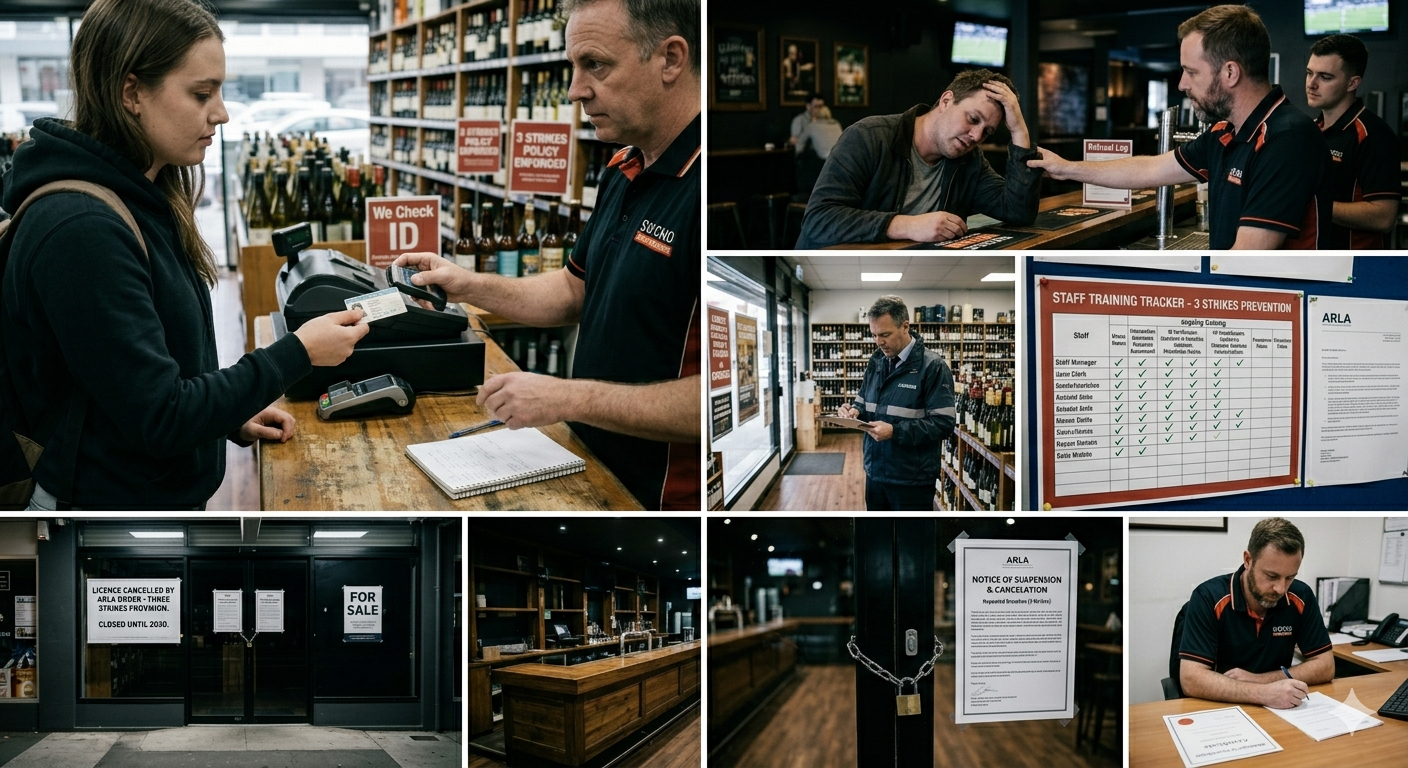
Section 288 of the Act is one of the most consequential provisions a licensee can fall foul of. If ARLA finds a licensee or manager has breached specific provisions three times within three years, the licence or manager's certificate can be cancelled — and cannot be reapplied for for five years.
The specific offences include selling alcohol to minors, selling to intoxicated persons, and breaching advertising and promotions rules. These are precisely the situations that trained, properly supervised staff are equipped to prevent. They are also precisely the situations that arise when training is absent, superficial, or treated as a one-off induction rather than an ongoing operational culture.

The Duty Manager Cannot Do It Alone
A common misconception in the industry is that compliance is the duty manager's problem. In reality, the duty manager depends entirely on the behaviour and judgement of the staff around them. A duty manager on shift with five untrained staff members is exposed regardless of how well-qualified they are personally.
The Act requires a certificated manager on duty at all times. But it does not say that manager can somehow override the actions of undertrained staff who serve an intoxicated patron or fail to check ID. When a breach occurs, it is the manager's certificate that gets suspended — and often the licence that follows.
Proper training creates a floor of competence across the entire team. When every staff member knows how to:
Identify signs of intoxication under the Act's definition
Refuse service politely but firmly
Ask for and assess acceptable ID
Understand the three approved forms of identification
Manage difficult customer interactions without escalating to conflict
Record incidents appropriately
...the duty manager is protected, the licensee is protected, and — most importantly — the public is protected.

The LCQ: The Foundation, Not the Ceiling
The Licence Controller Qualification (LCQ) is the mandatory qualification for anyone seeking a manager's certificate under the Act. It covers the legal framework, host responsibility obligations, and practical compliance requirements. It is the minimum standard — and it should be treated as exactly that: a foundation, not a destination.
Good operators use the LCQ as a starting point and build on it with:
On-site inductions specific to the premises and its licence conditions
Regular team briefings on compliance expectations, especially during high-risk periods (late nights, events, end of semester, etc.)
Refresher training when practices drift or incidents occur
Documented training records that can be produced in the event of an inspection or hearing
That last point matters more than many licensees realise. When a licensing inspector or Police officer attends premises following an incident, one of the first things they will ask is: what training have your staff received, and when? A folder of signed training records is evidence of a culture of compliance. The absence of such records is evidence of the opposite.

What DLCs Look For
At the licensing application and renewal stage, DLCs scrutinise whether an applicant has appropriate systems, staff and training in place. This is not abstract — applicants are asked to describe their host responsibility policy, their training programme, and how compliance is monitored day-to-day.
Applicants who can point to a structured staff training programme, clear incident management procedures, and regular refresher training are demonstrating that they understand what the Act requires and are committed to meeting it. Those who cannot are raising a red flag — particularly at renewal, where the DLC must consider whether the premises has been conducted in a proper manner and whether the licence should continue.
The Business Case Is Obvious
Beyond the legal and regulatory obligations, the business case for staff training is straightforward.
A 48-hour licence suspension costs a venue its entire weekend trading — typically the highest revenue period of the week. A 96-hour suspension, as faced by Dakota Bar, wipes out four days of income. A manager's certificate suspended for 28 or 56 days means staffing disruption, loss of experienced personnel, and reputational damage.
These are not hypothetical risks. They are documented outcomes from decisions published on the ARLA website, available for anyone to read — including your customers, your landlord, and the next licensing inspector who walks through your door.
Training is cheap. Suspensions are expensive. Cancellations are catastrophic.